Why Google Rewrites Your Meta Description
Google replaces the meta description you wrote more often than not. Here's what actually triggers a rewrite and how to write descriptions it keeps.
Write a tight, keyword-aware meta description for a WordPress page, check the search result a week later, and there's a decent chance Google is showing something else entirely — often a sentence lifted straight from your body copy, sometimes stitched together from two different paragraphs. This isn't a bug in your SEO plugin and it isn't a sign your description was written badly. Google rewrites meta descriptions on a large share of search results, by its own published research, and it does it for reasons that have very little to do with how good your original description was.
What actually triggers the rewrite
Google generates its own snippet when it decides the query the searcher typed is better served by something more specific than the fixed description every visitor sees. A few concrete triggers:
- The query doesn't match your description's framing. Your meta description covers the page in general; the searcher typed something narrower. Google will pull the sentence from your body content that answers that specific query, because it serves that searcher better than your generic summary.
- The description is too short or too generic to be useful. "Learn more about our WordPress plugin for SEO" tells Google nothing worth keeping. A description needs to carry real, specific information — what the page actually covers — or Google treats it as filler and writes its own.
- The description doesn't match the page's actual content closely enough. If the written description oversells, undersells, or just drifts from what the page is really about, Google's generated snippet (built from the page itself) will usually be more accurate, and more accurate wins.
- The description is near-duplicate across many pages. Templated descriptions — the same sentence with one word swapped across fifty product pages — read as low-information to Google's snippet system and get overridden more often than unique, page-specific ones.
- Length and truncation push Google to prefer a different excerpt. A description that runs long and gets cut mid-sentence can look worse in the SERP than a cleanly-bounded excerpt Google pulls from your content, so Google uses the latter.
None of this means meta descriptions are pointless to write. Google's own guidance is that a good, specific, page-matched description is still used — it's the generic, mismatched, or duplicated ones that get replaced.
How to write descriptions Google is more likely to keep
- Make it specific to this exact page, not the template. Name the thing this page actually does differently from the page next to it. "Bulk-fix missing alt text across WooCommerce product galleries without opening each image" beats "The best WordPress plugin for your store" because it's a claim Google can verify against the page content — and a searcher can verify against their own need.
- Match the description to the query intent the page is built for, not just the keyword. If the page answers "how do I fix X", write the description as the promise of that answer, not a feature list.
- Keep it inside the display limit, finishing on a complete clause. Aim for roughly 120–155 characters. A description that's cut off mid-word in the SERP looks worse than Google's own excerpt, which is one more reason Google overrides it.
- Don't template it across near-identical pages. If fifty pages share a structure, each description still needs one specific, differentiating detail pulled from that page — a number, a scope, a named feature — not just the product name swapped in.
- Check what Google is actually showing, not just what you wrote. Search your own page in an incognito window periodically. If the live snippet consistently differs from your written description for the same query, that's a signal the description needs a rewrite, not that Google is being unreasonable.
- Match the description to the title tag, not to each other's history. A description that just restates the title tag in different words gives Google little new information to work with; one that adds a distinct detail (price, scope, time-to-complete) gives Google a reason to keep it as written.
A quick way to tell if it's working
Pull up Google Search Console's Performance report, filter to a page, and compare its impressions-to-clicks ratio against similar pages on your site. A page whose live snippet keeps getting rewritten to something generic or off-target will usually show a lower click-through rate than a comparable page whose written description is being used as-is — because a Google-generated excerpt, pulled to match the exact query, is sometimes more relevant than a one-size-fits-the-page description, but a mismatched or low-information one performs worse than either.
One more distinction worth making here: the meta description tag and the Open Graph og:description tag are not the same thing, even though WordPress SEO plugins often let you set both from the same settings panel. The meta description is what Google may or may not use for a search snippet; og:description is what Facebook, LinkedIn, Slack, and other platforms show when someone pastes your URL into a chat or a post. Google rewriting your search snippet has no effect on what those platforms show when the link is shared — and the reverse is true too. If a page needs a different framing for a social share than for a search result — a punchier hook for social, a more literal summary for search — most SEO plugins let you set the two fields independently. Treating them as interchangeable is a common reason a page's social preview looks oddly generic even when its search listing reads fine, or the other way round.
Frequently asked questions
Can I force Google to always use my written meta description?
No — there's no tag or setting that guarantees it, including on WordPress with Yoast, Rank Math, or AIOSEO. Google has stated plainly that it generates snippets independently of the meta description tag when it judges a better match exists for the query. The lever you control is writing a description specific and accurate enough that Google has less reason to override it, not a setting that forces compliance.
Does a rewritten meta description hurt my SEO rankings?
Not directly — the meta description isn't a ranking factor, and Google confirms this. What it affects is click-through rate on the result you've already earned. A generated snippet that happens to match the searcher's exact query can sometimes outperform your written one; a generic or mismatched generated snippet usually underperforms a well-written, page-specific description. Either way, the fix is the description, not anything to do with rankings.
Why does Google show a different snippet for the same page depending on the search query?
Because Google tailors the snippet to the specific query whenever it judges that a more targeted excerpt from your page content serves that searcher better than your one fixed description. The same page can rank for dozens of different queries, and a single static description can't be the best match for all of them — so for queries where the mismatch is large enough, Google pulls a more relevant sentence straight from your content instead.
If you're running OpptiAI Titles alongside Yoast, Rank Math, or AIOSEO, it flags meta descriptions that are missing, too generic, or too close to a template duplicate across your site, and drafts a page-specific replacement you review before it's applied — rather than leaving it to guesswork which descriptions Google is quietly ignoring. OpptiAI Titles runs the scan.
Related Posts
Use Search Console CTR Data to Fix the Right Titles First
Rewriting every title tag wastes effort. Search Console's CTR data shows exactly which ones are losing you clicks, so you fix those first.
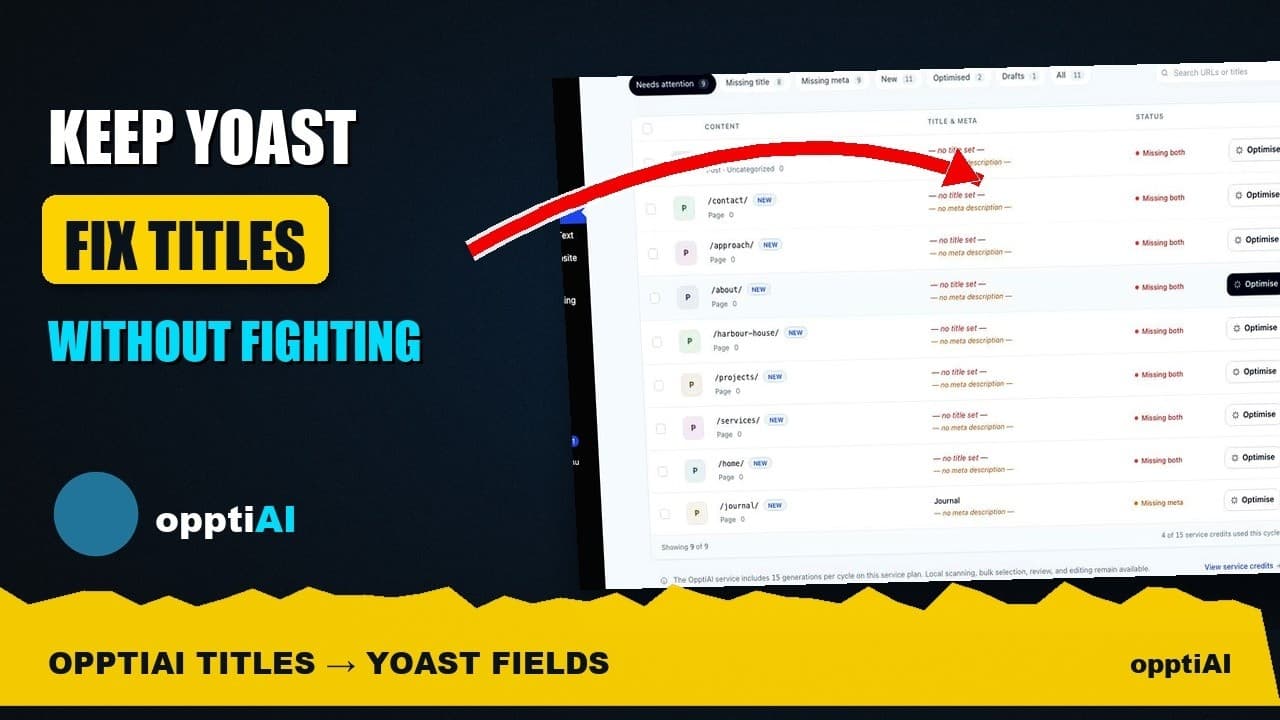
See Your WordPress Title Fixes Show Up Inside Yoast
Fixed a weak title in an audit tool but not sure Yoast picked it up? Here's exactly where to check, and what it means if the two disagree.
How to Write Meta Descriptions That Improve CTR
A meta description under the limit can still fail to earn clicks. What actually moves click-through rate once the length problem is solved.