Who OpptiAI Alt Text is for
OpptiAI fits WordPress sites where the Media Library has outgrown manual editing — typically a few hundred images upward, or any WooCommerce catalogue with product galleries. Bloggers with sporadic uploads may stay on the free tier indefinitely; agencies remediating client libraries, publishers with archival depth, and stores with CSV import churn benefit most from bulk generation plus review-before-save.
It is less suited to sites with a dozen bespoke images under legal sign-off, or libraries that are almost entirely decorative with a documented empty-alt policy. For broader context on coverage and audits, start with the WordPress image SEO hub.
Agencies managing multiple client sites benefit from predictable per-site pricing and a workflow clients can understand: scan coverage, approve a batch, report the before/after number. Publishers with deep archives can prioritise recent stories first, then work backward through evergreen content that still earns search traffic.
How review-before-save works
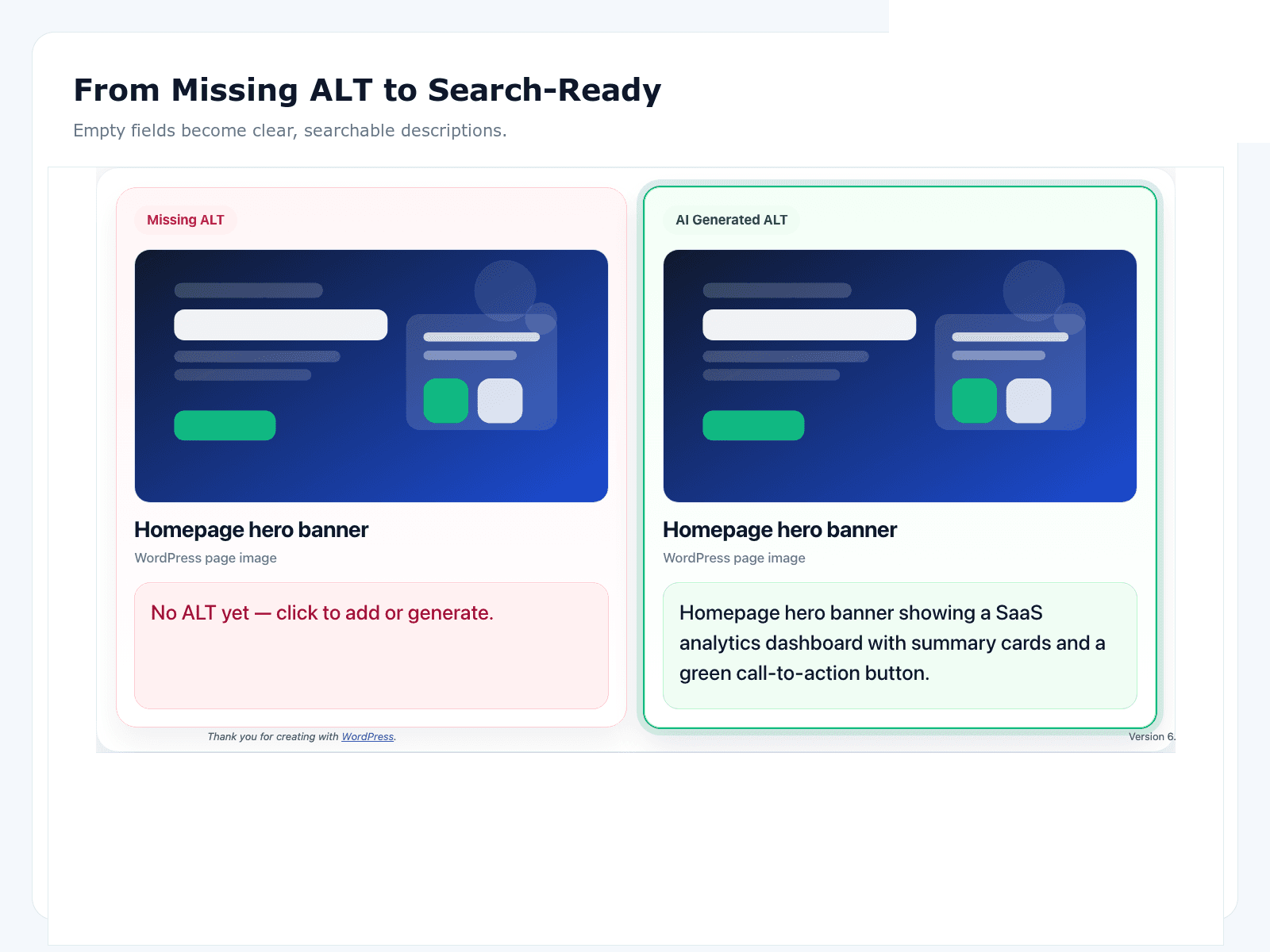
Review-before-save means AI drafts never overwrite live alt without your approval — scan the library, generate batches, edit in the ALT Library workspace, then save when satisfied.
That human gate matters because vision models misread materials, confuse similar products, or describe background details instead of the subject you sell. A two-minute QA checklist — accurate colour, correct product type, no competitor names, no keyword stuffing — keeps errors out of production faster than fixing them site-wide after autopilot runs.
New uploads can follow the same loop: automatic draft generation with optional auto-approve only when you trust the volume and content type. Most teams keep approval on for product and editorial photos.
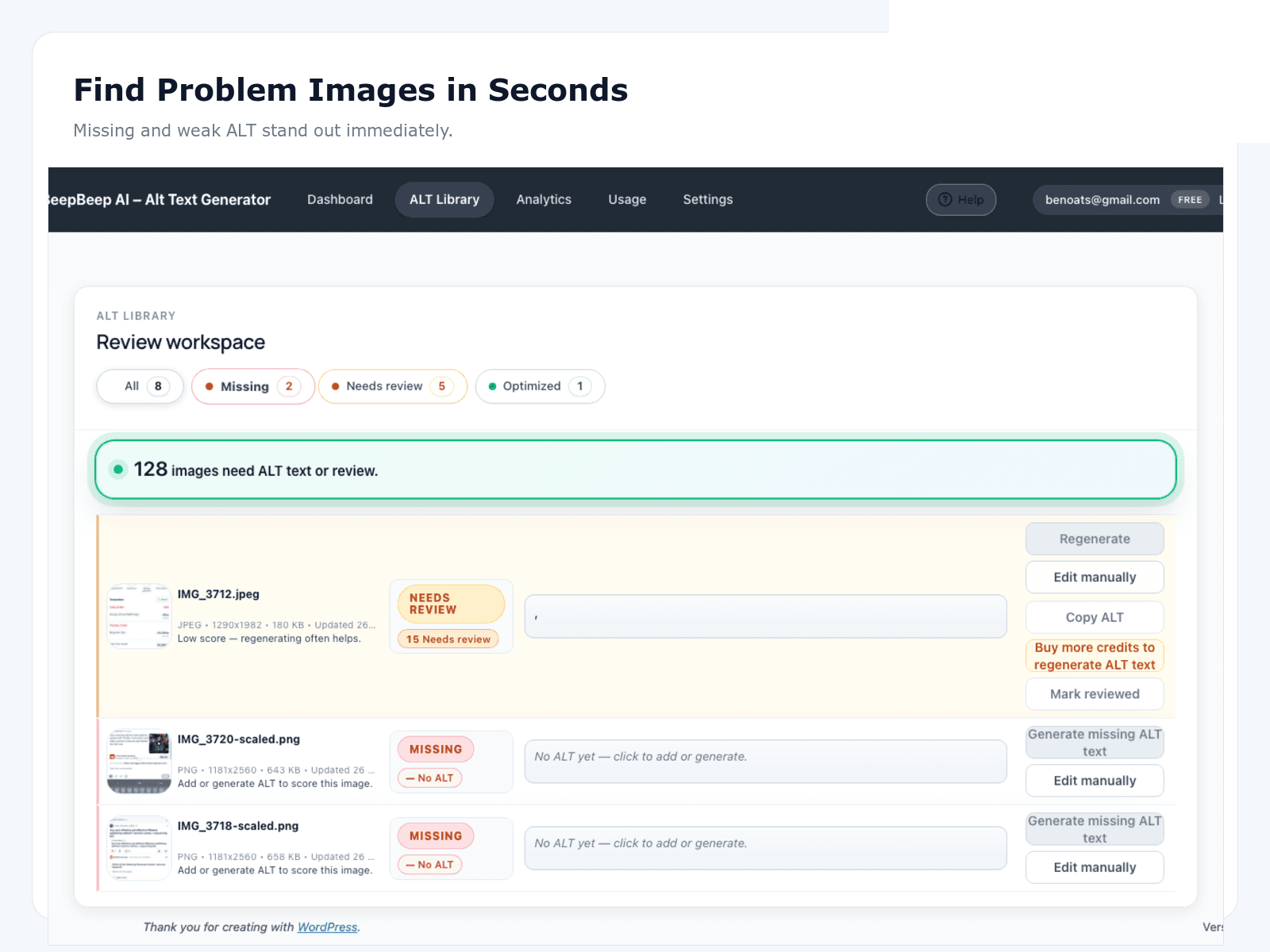
The ALT Library workspace surfaces missing and weak alt in one list — you are not hunting through the Media Library grid attachment by attachment. Edit inline, score quality if needed, and approve batches when the queue looks right. That is the difference between AI that helps and AI that creates a second cleanup project.
WooCommerce product and gallery images
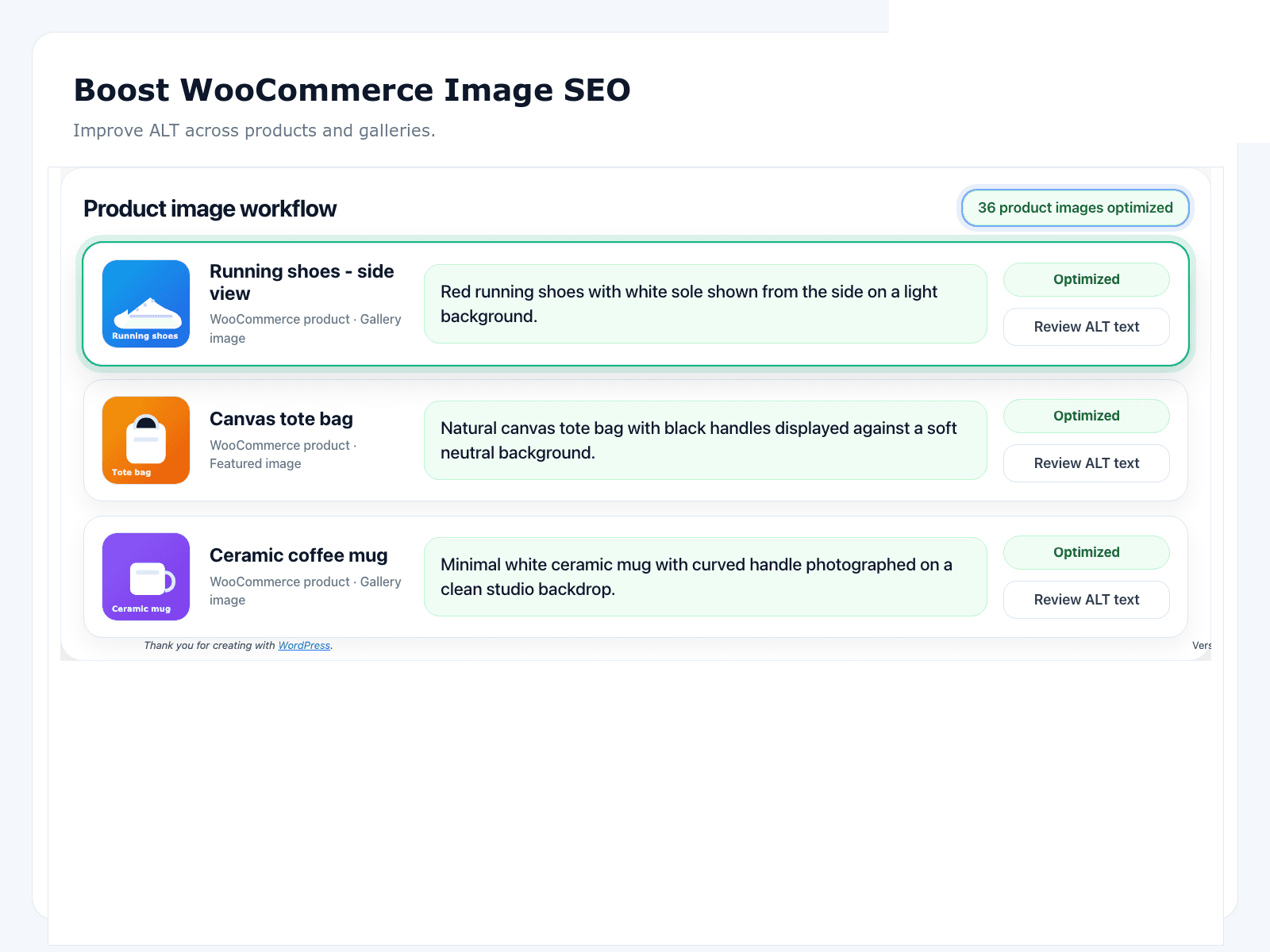
WooCommerce stores remediate featured images, gallery slots, and many variation images from the same Media Library workflow — no separate product-screen loop for every SKU.
Pilot on twenty bestsellers with multi-image galleries before touching the long tail. CSV imports without alt columns are the usual regression — pair remediation with import checklists and periodic rescans. Store-specific buying criteria live in the best WooCommerce alt text plugins guide and the for-woocommerce hub.
Variation images for colour and size need specific alt — not six copies of the parent product title. Decorative sale bursts should stay empty. OpptiAI filters informative product shots from theme chrome so bulk runs do not stuff alt into badges shoppers never hear described aloud.
How it compares to SEO suites
Yoast, Rank Math, AIOSEO, and SEOPress own titles, meta descriptions, schema, and on-page analysis — they are not built to queue thousands of Media Library attachments for AI drafts with approval.
Keep your SEO suite installed. Add OpptiAI for alt text at library scale. The jobs do not conflict. See Yoast SEO alt text for how the split works, and the alternatives library for head-to-head notes on other dedicated tools.
Image compressors remain separate — OpptiAI does not replace ShortPixel or your host optimiser for WebP conversion and file weight. Three tools, three jobs: suite for on-page SEO, OpptiAI for alt at scale, compressor for performance.
vs AltText.ai, BYOK plugins, and compressors
AltText.ai offers strong ecommerce workflows but leans more autopilot-oriented — verify the review step matches your QA bar. BYOK plugins are free to install but require your own OpenAI or provider API key and token budgeting. ShortPixel bundles alt generation with image compression; useful if you already pay for their optimiser, but confirm overwrite rules before bulk runs.
OpptiAI combines managed generation (no API key), review-before-save by default, and a free WordPress.org tier. Read the AltText.ai alternative breakdown and the best WordPress alt text plugins comparison for an honest feature matrix — no invented star ratings.
If you already pay for ShortPixel or similar, test their bundled alt against a dedicated trial on the same hundred images — overwrite behaviour and review UX matter more than consolidating vendors on paper.
Getting started: install → scan → bulk-fix
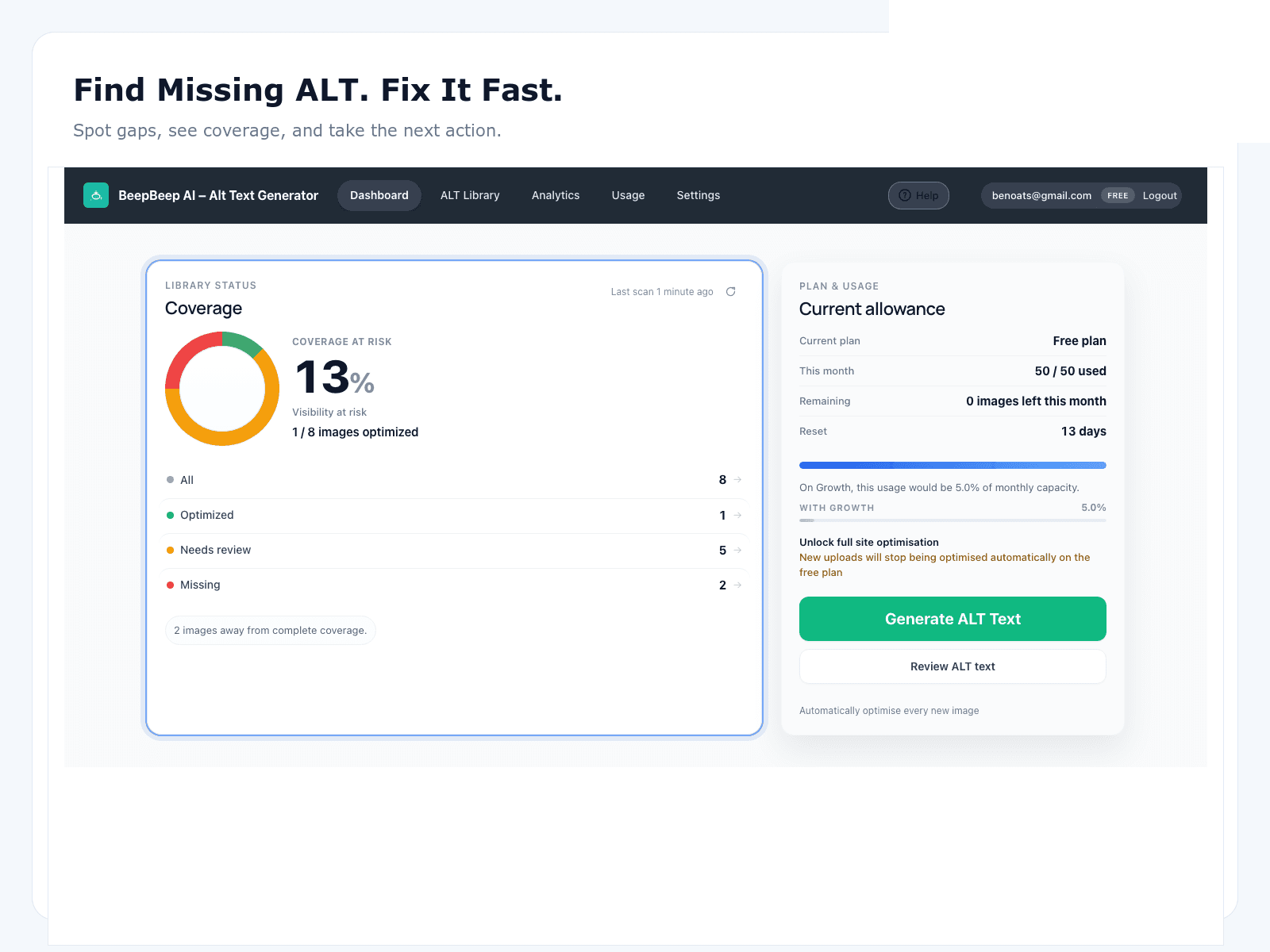
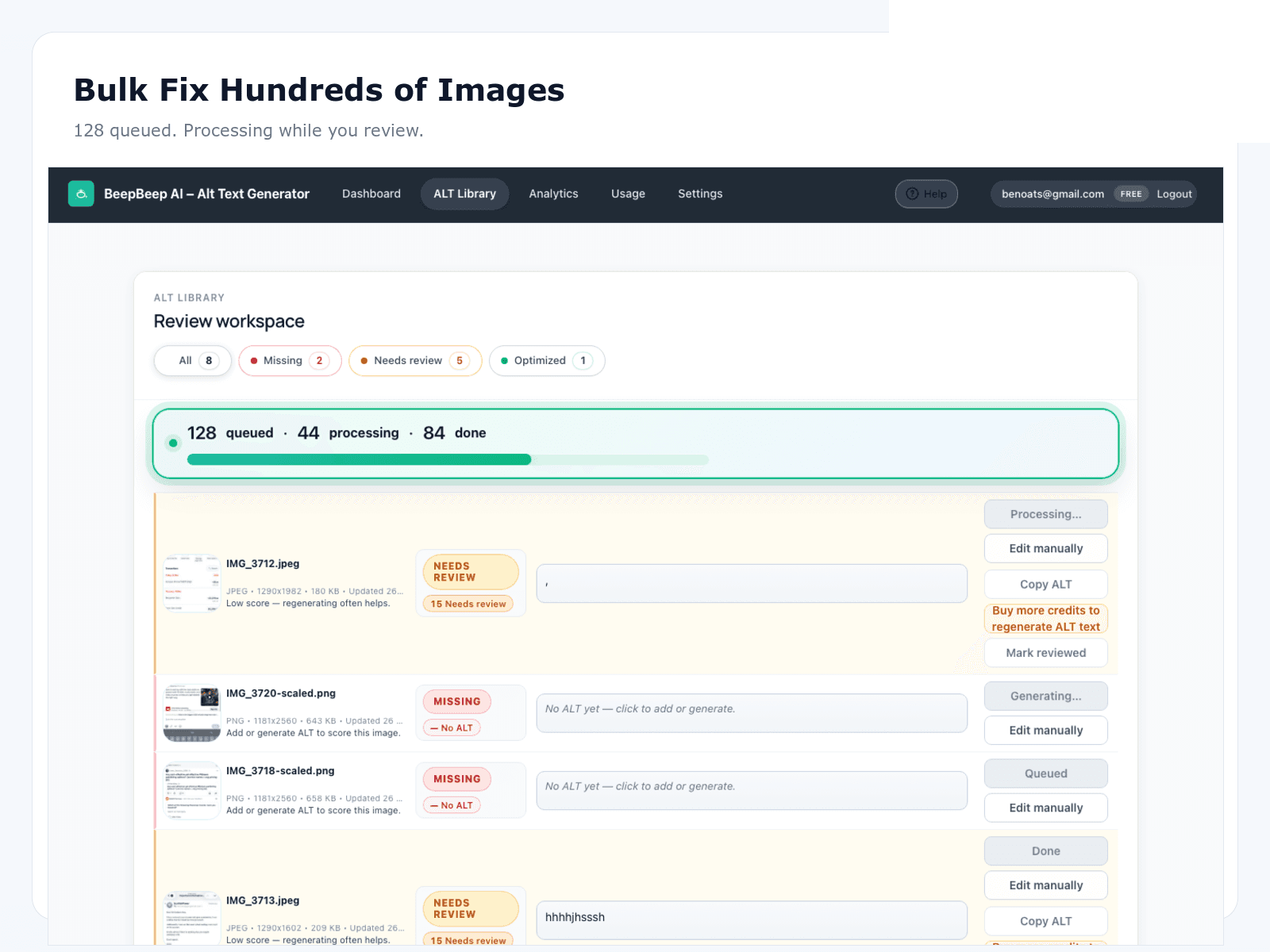
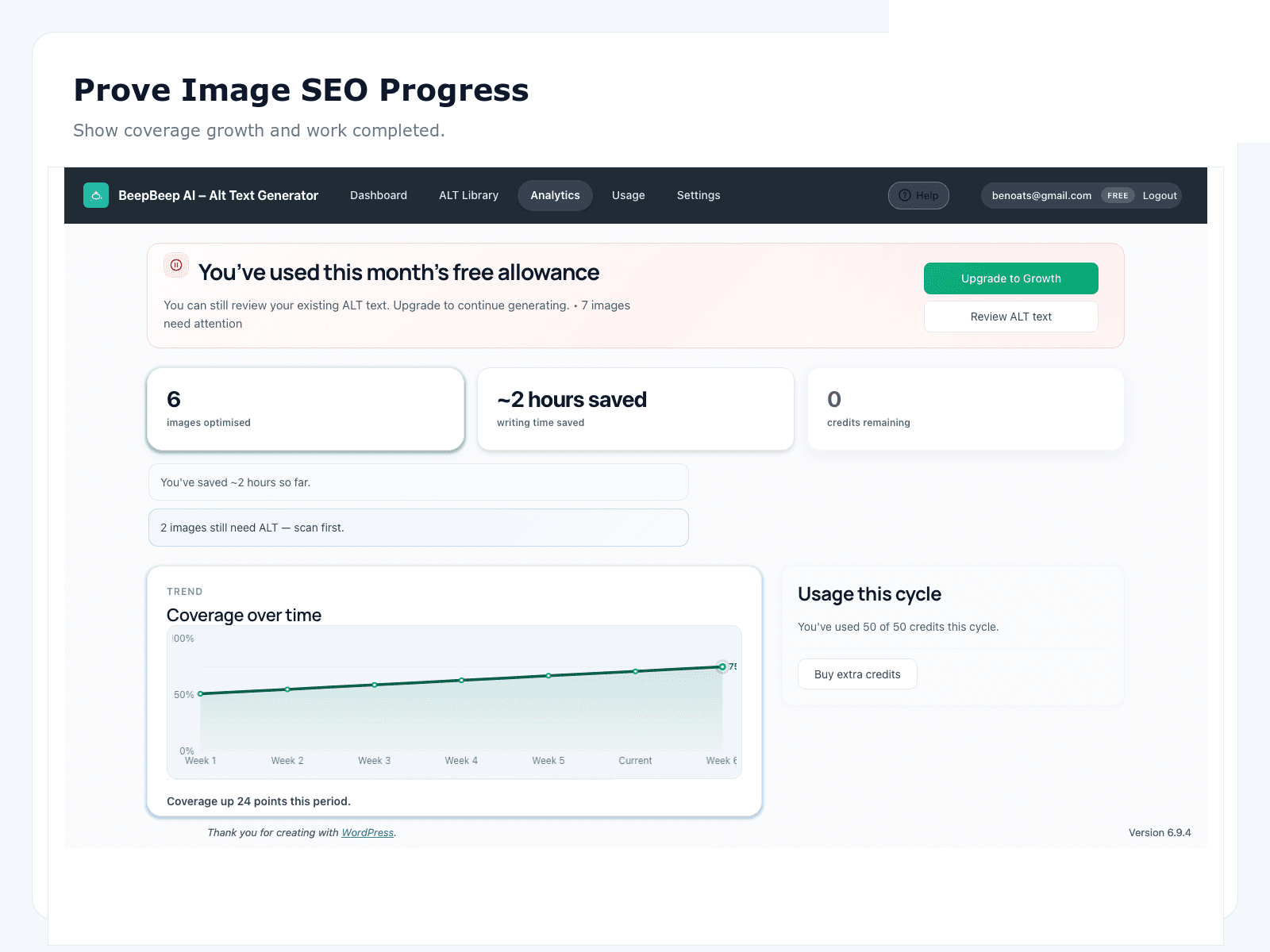
Install free from WordPress.org, open the dashboard, and scan coverage — you will see missing and weak alt as a number, not a guess. Queue a pilot batch of a few hundred recent uploads, review in the ALT Library, save, then expand to the full archive.
For the full operating model — batch sizing, QA checklists, and keeping new uploads covered — follow the bulk alt text for WordPress workflow. Run a free public-page audit first if you need stakeholder screenshots before opening wp-admin.
Upgrade when the free tier limit bites — usually after the first remediation sprint on a mid-size library. Paid plans add volume and automation so new uploads stay covered without reopening the backlog every quarter. Start on the free tier, prove the workflow on live content, then scale.