What we did
- Wrote a one-page alt standard for reporters and producers.
- Enabled generate → review → save on new featured images.
- Bulk-cleaned homepage, section hubs, and evergreen explainers.
- Sampled weekly coverage so editors could see drift early.
Newsroom context: volume without ownership
High-volume publishers ship dozens of images a day. Without a written standard, alt text becomes whatever the CMS field happens to contain — captions pasted wholesale, filenames, or blanks. Accessibility leads get questionnaire pressure; SEO leads notice thin Image search presence on explainers that should rank for years.
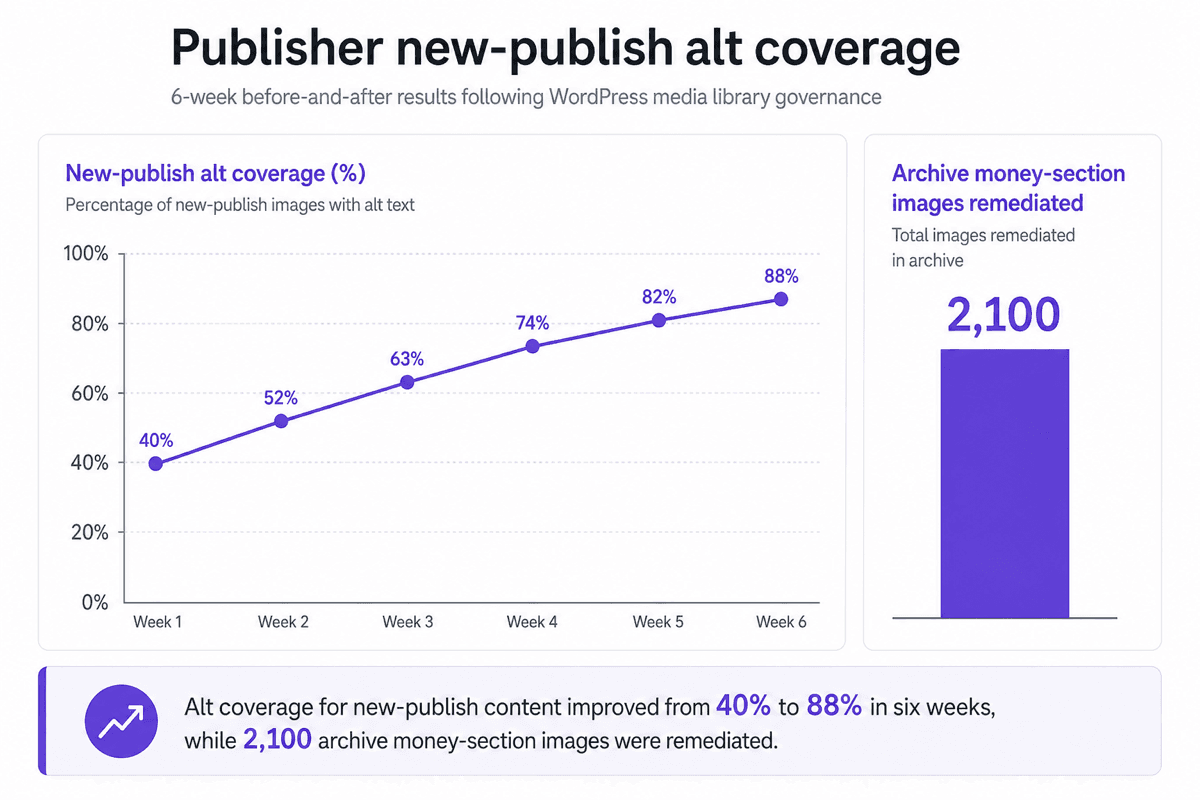
This composite newsroom ran WordPress with a central desk, freelance contributors, and a photo desk that uploaded crops faster than anyone reviewed metadata. New publishes averaged roughly 40% useful alt on informative featured images — and that number was a generous sample, because many chron posts used decorative crops that had been keyword-stuffed instead of left empty.
- Regional news + lifestyle verticals; ~60–90 images published per weekday
- Money sections: homepage, politics, business, and evergreen explainers
- No dedicated accessibility retainer; SEO team owned the remediation brief
- Six-week window: governance first, then targeted archive cleanup
Governance before heroic cleanup
The first two weeks focused on stopping new debt. A one-page standard clarified informative vs decorative, banned filename alt, and required a human glance at AI drafts before save. Producers saw the review queue as part of the publish checklist — not a separate “accessibility project” they could defer to next quarter.
The photo desk agreed that chron templates with purely decorative lead crops would use empty alt by default. That single policy removed a recurring source of keyword stuffing that had been making coverage metrics look better than they were.
- One-page alt standard: informative vs decorative, max length, banned phrases
- Publish checklist updated: featured image alt reviewed before go-live
- Freelancers onboarded with two example pairs (good vs bad)
- Decorative chron crops: empty alt by policy — no exceptions without desk sign-off
Governance is the boring part that makes the cleanup stick. Oral standards do not survive shift changes, freelancer turnover, or “we will fix it after the election night live blog.”
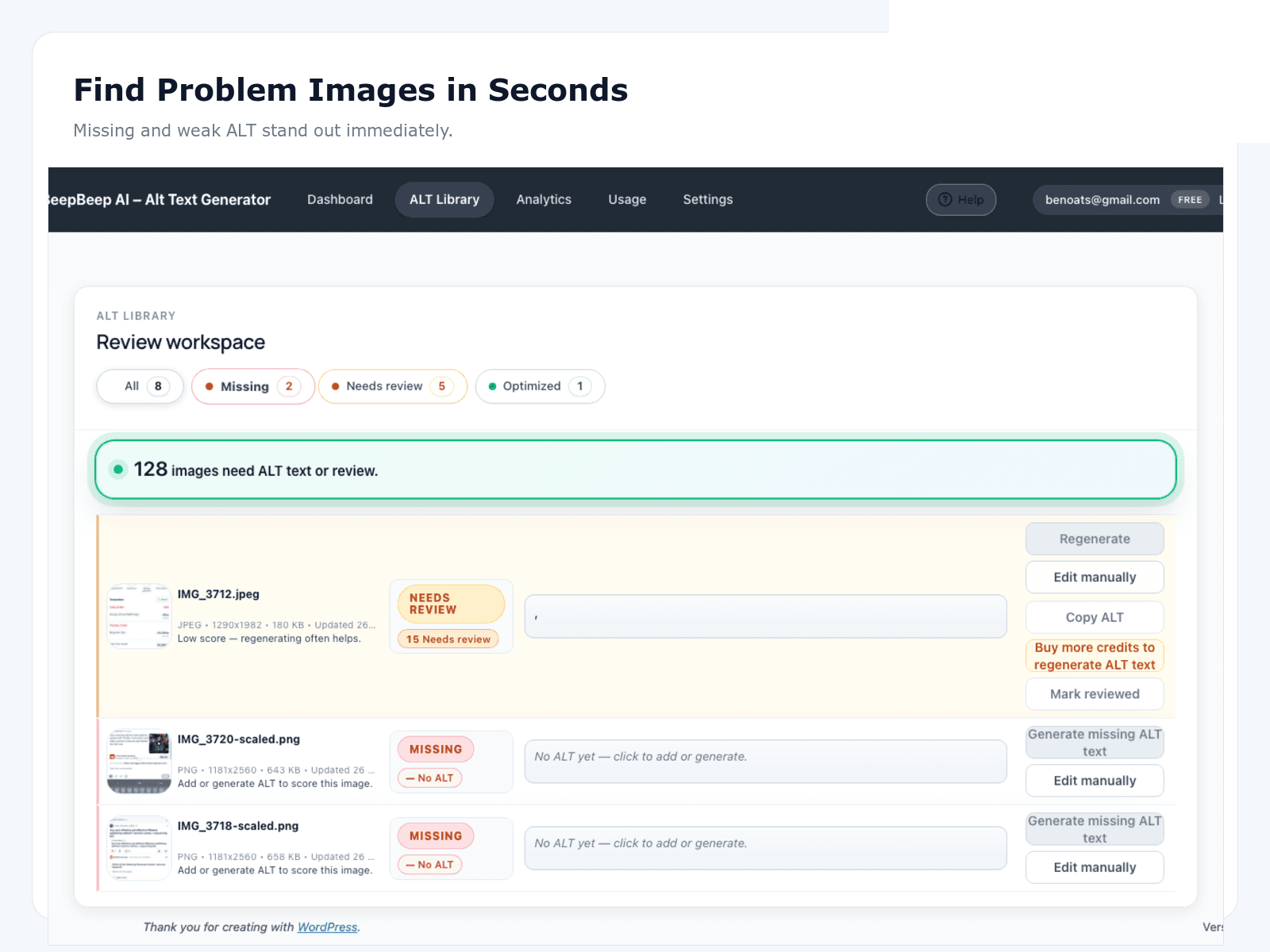
New-publish workflow: generate, edit, save
Once standards existed, the desk enabled OpptiAI’s generate → review → save loop on new featured images. AI drafts could see the crop and headline context; producers edited names, locations, and action verbs before save. Average approval time settled around 20–40 seconds per image — fast enough for a busy desk, slow enough to catch wrong attributions.
Reuse was the harder edge case. When the same wire photo appeared in three stories, alt text had to match each URL’s angle — not copy the first draft forever. The standard said: re-check alt when re-attaching an asset to a new post, even if the file already lived in the library.
- Featured images on new publishes: AI draft + required human review
- In-article photography: reporter or producer owns meaning; SEO samples weekly
- Wire reuse: alt must reflect this story’s context, not the first upload
- Breaking news: short alt allowed; accuracy beats length
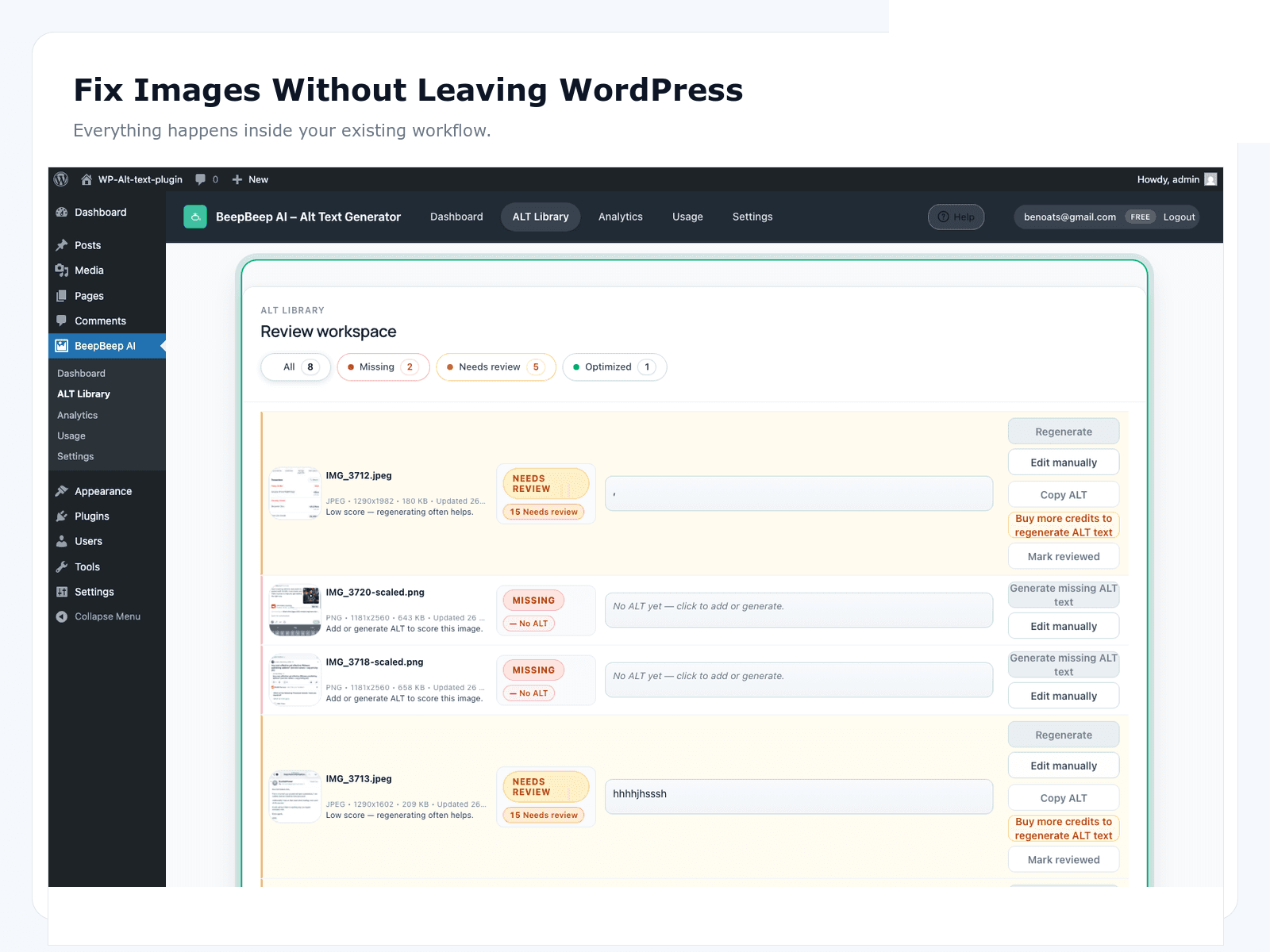
Targeted archive cleanup on money sections
Only after new-publish coverage stabilised did the team bulk-remediate money-section archives. Homepage heroes, section hubs, and evergreen explainers came first — roughly 2,100 images in scope. The chron firehose of same-day posts stayed out of Phase 1; trying to perfect ten years of breaking news would have buried the desk.
Bulk jobs ran in batches of a few hundred with the same review gate. Editors prioritised explainers that still earned organic traffic and Image search impressions, not posts that had already fallen off the index.
- Phase 1 archive scope: ~2,100 images across money sections
- Excluded: same-day chron posts older than 18 months unless evergreen
- Batch size: ~250 images to keep QA fresh
- Decorative crops in archive: cleared to empty alt where policy applied
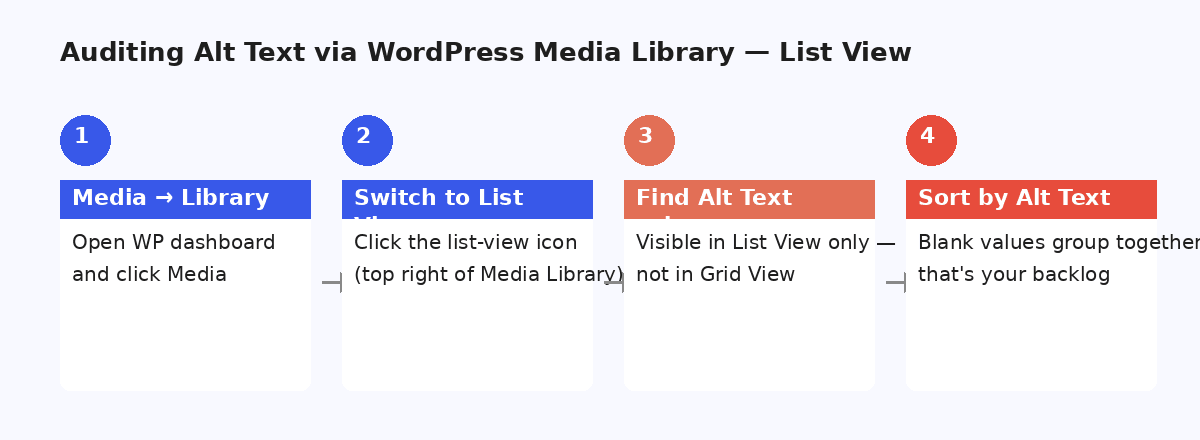
Measuring coverage without gaming the metric
The SEO lead sampled 50 new publishes per week across top sections — not “every attachment ever uploaded.” Useful alt meant human-readable, specific to the image, and empty only when decorative. Filename strings and caption paste counted as failures.
By week six, sampled new-publish coverage sat near 88%. Archive money-section useful alt moved materially on re-audit, though the team did not claim a site-wide percentage that included a decade of chron posts.
Sample honestly. A newsroom that counts keyword-stuffed decorative crops as “covered” will look green on a spreadsheet and still fail a public-page audit on the homepage.
What did not magically happen
Image search traffic did not triple because explainers got better alt text. Some evergreen URLs saw cleaner Image search snippets over time, but breaking news remained a different game — freshness and relevance dominate, not alt strings alone.
The newsroom also did not remediate every historical attachment. That was intentional. Governance plus money-section cleanup closed the gaps procurement and public audits would actually see, without pretending a six-week project fixed a fifteen-year library.
- No sitewide “100% alt coverage” claim including the full chron archive
- No named newsroom or editor testimonial
- No promise that caption text can always substitute for alt
- No silent bulk overwrite — review gate stayed on for archive batches
Reuse this playbook in your newsroom
If you run a WordPress publisher, mirror the sequence: write standards, fix new publishes first, bulk-clean money sections, sample weekly so drift is visible. The publishers playbook goes deeper on roles, audit cadence, and reuse rules.
Pair operational work with the WCAG image guide for decorative policy language — and use free public-page audits on section hubs before anyone argues the gap is “just a few images.”
- Stop new debt before boiling the ocean archive
- Document decorative policy — oral rules fail at shift change
- Sample new publishes weekly; quarterly sweep on high-traffic URLs
- Re-check alt when reusing wire assets across stories
- See the publishers playbook for the full operating model
Takeaways
- Stop the bleed on new publishes before boiling the ocean archive.
- Write the decorative policy down — oral standards do not survive shift changes.
- Measure weekly samples so coverage drift is visible early.
- Money-section cleanup earns procurement wins; chron firehose can wait.
FAQ
Should every news image have keyword-rich alt?
No. Informative images need concise, accurate descriptions. Decorative crops and spacer images should be empty. Caption text and alt text are related but not identical jobs.
Who owns alt in a newsroom — reporters or SEO?
Reporters and producers own meaning on new publishes; SEO owns standards, sampling, and audit cadence; engineering owns bulk tooling permissions. AI drafts sit in the middle — humans approve before save.
Do we need to remediate the entire archive?
Not in Phase 1. Prioritise homepage, section hubs, and evergreen explainers that still earn traffic. Chron firehose posts are often out of scope until governance stops new debt.
How is this different from a WooCommerce catalogue cleanup?
Publishers optimise for reuse, breaking-news speed, and desk workflow — not SKU galleries. The governance and sampling cadence matter more than hitting 95% on every attachment ever uploaded.